The short version
- Because people normally write Hebrew without vowel marks, one written form can stand for several different spoken words.
- Short words like "and," "the," "in," "when," and "that" attach to the next word, packing a whole phrase into a single written word.
- Slang, borrowed words, and names have no fixed spelling, so a transcript can be valid and still not match the spelling you expected.
- Natural conversation is faster and looser than the formal Hebrew you see in most written text.
- Checking the transcript goes fastest when you know these patterns and listen closely wherever they show up.
Why does missing vowel marking matter?
Modern Hebrew is written mostly with consonants. Vowel marks exist to show exact pronunciation, but adult books, news sites, and everyday messages leave them out. People who know the language do not need them because they read the whole sentence at once.
Speech recognition works the other way around. The software hears the vowels and has to figure out which written word they belong to. The spoken words sefer (a book), sapar (a barber), and siper (he told) are all written with the exact same three letters. Context is the only way to tell them apart, and there is not much context when a speaker mumbles, switches topics, or uses an unusual word.
How do attached prefixes change the problem?
Small connecting words stand on their own in English. In Hebrew, many of them attach right onto the start of the next word, including "and," "the," "in," "to," "from," "like," "when," and "that." The phrase "and when I saw" is written as a single string of letters. A transcription system has to figure out where those prefixes stop and the root word starts, and then spell the whole cluster right.
Because of this, the working vocabulary is much larger than it looks. Any noun or verb can take dozens of prefix combinations, and a rarer combination might show up only once in a long recording. Even if the system knows the base word well, it may never have heard it with that specific string of prefixes. When that happens, a prefix can get dropped, added by mistake, or stuck onto the wrong word.
While reviewing, keep an eye out for sentences where the grammar feels slightly off. A missing "the" or connecting word usually means a prefix got dropped.
Is there one correct spelling?
Hebrew uses two common spelling styles. The fuller style adds extra letters to stand in for vowels, while the shorter style leaves them out. Both show up in print, and writers often mix them in the same text. Borrowed words add even more variety. You will see "email," "mail," and a hyphenated version of the word used side by side every day, and the same goes for many product and place names.
For someone reading the text, this just means two transcripts of the same sentence can look different without either one being wrong. It causes more trouble when you try to search the file. If you search for one spelling of a word and the transcript used another, you might come up empty. Whenever a specific name or term matters, search for every spelling variant before assuming nobody said it.
Pick one spelling for names, brands, and key terms before you start editing, and stick to it throughout. Keeping the file consistent makes it much easier to search, quote, and hand off.
What about slang and fast speech?
Spoken Hebrew is very different from newspaper Hebrew. Everyday speech uses common words like yalla, sababa, and wallah, which can be spelled several ways when written down. Speakers also shorten syllables, leave sentences unfinished, and talk over one another. In a meeting, one sentence might even be split across two speakers.
Large bodies of written Hebrew are mostly formal text. It is much harder to gather and verify recordings of natural conversation, especially when speakers have regional accents or use work jargon. Because of that, a recognizer will handle a clear lecture more reliably than a lively chat in the kitchen, even if the exact same person is speaking.
Plan for this by treating informal recordings as drafts that will need a careful listen. If a recording includes unusual local words that matter, you can also add a few lines of context.
Why are names and foreign words so risky?
Names bring all of these problems together more clearly than anything else. A name might be written without vowels, take an attached prefix, have several accepted spellings, and only come up a few times in the audio. A foreign name spoken with a Hebrew accent makes it one step harder.
Getting a name wrong also causes the biggest headaches, since it can change who said or did what. Listen back to the audio to check every name, and pick one spelling to use throughout the file.
How do you review a Hebrew transcript efficiently?
These patterns can guide your review. Watch for sentences with odd grammar, since that usually points to a dropped prefix or a swapped word. Search for names and key terms under every spelling they might take, and play the audio whenever a word can be read two ways that change the meaning.
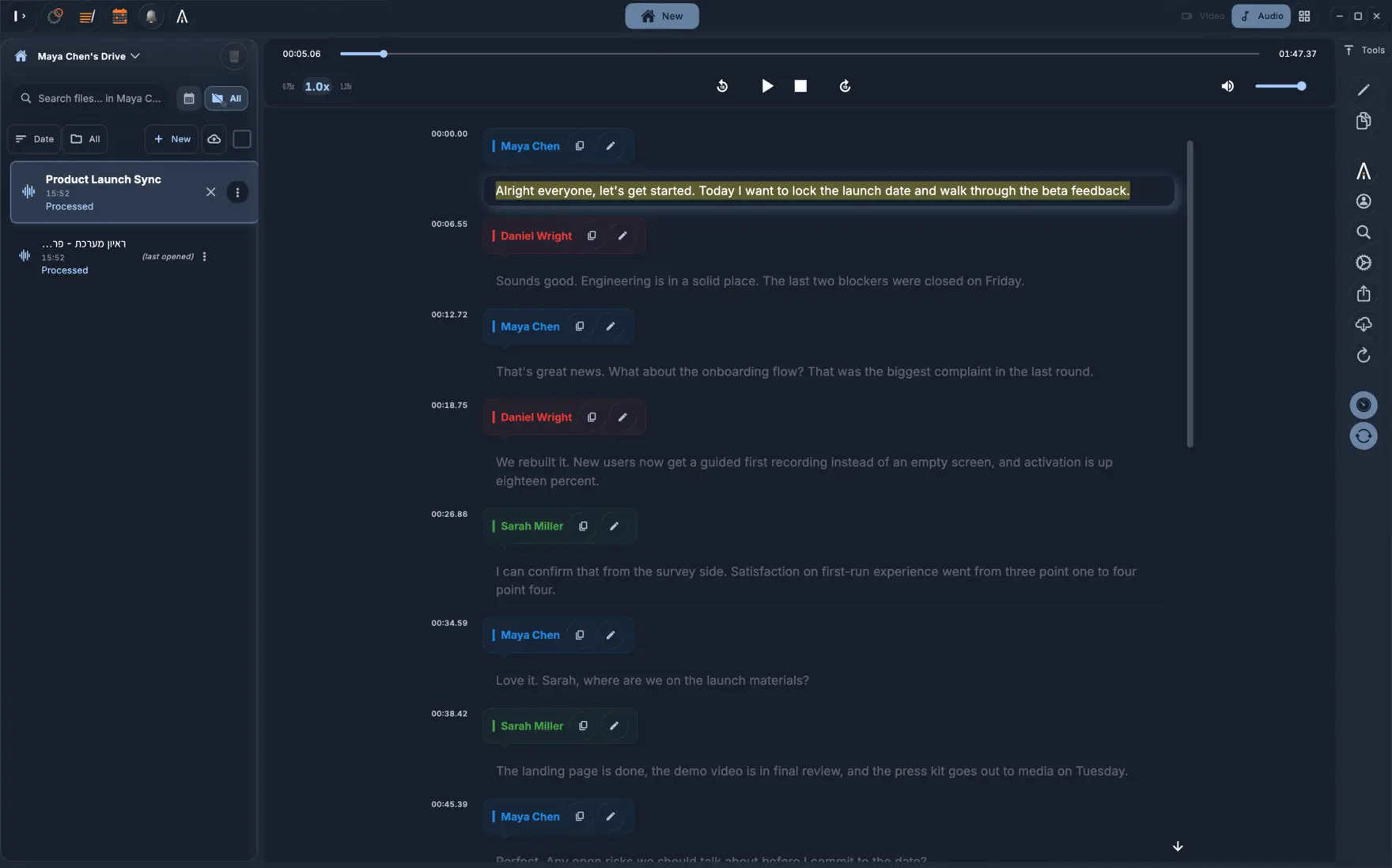
Hebrew is a core language in KolWrite, which keeps the text, speaker labels, and timestamps tied together so you can jump to any moment and listen. Because automatic text always has mistakes, a quick review pass is what makes it safe to share. For the broader question of how accuracy is measured, see the page on Hebrew transcription accuracy.
Common questions
Is Hebrew harder to transcribe than English?
It has different problems rather than simply being harder. Unwritten vowels, attached prefixes, and flexible spelling cause issues you do not see in English, while English has its own headaches like irregular spelling.
Why does the transcript sometimes drop a small word?
In Hebrew, short words like "the," "and," and "that" attach to the start of the next word and get said very quickly. They are easy for a recognizer to miss, so watch the grammar as you read and check the audio whenever a sentence feels incomplete.
Will slang words be written correctly?
Common slang usually gets picked up, though it can be spelled in different ways. Pick the spelling you prefer and make it consistent while you edit.
Can I add vowel marks to a transcript?
Transcripts use standard Hebrew spelling without vowel marks. If you need vowels for teaching or accessibility, you can add them in your word processor after you finish editing the text.
How can I check a name quickly?
Search the transcript for the different ways the name might be spelled, click the timestamp on each match to hear the audio, and change them all to a single spelling.