The short version
- Ask the candidate for permission before recording. Explain what the recording is for, and let them decline without penalty.
- Use transcripts to inform human judgment rather than replace it, and never let software score candidates.
- Ask every candidate the same core questions and score them against the same criteria, citing their actual words.
- Limit who can read interview records. Decide upfront how long you will keep them and when you will delete them.
- Employment and privacy rules vary by country and role. Check with your legal or HR adviser, and verify automated text before relying on it.
Why transcribe a job interview?
When interviewers take notes by hand, they miss details, and their first impressions often color what they write down. A transcript captures what the candidate actually said. The interviewer can focus on listening instead of typing, and the whole hiring panel gets the same record to review.
Comparing candidates gets easier, too. When several people answer the same questions, reading their responses side by side is much more reliable than relying on memory. And if a role requires specific expertise, a technical colleague who missed the call can still review the answers later.
Still, be realistic about what a transcript shows. It only captures words, not ability. How someone sounds is affected by pauses, accents, nerves, or a bad connection, and none of those tell you how well they will do the job. Use the text to verify what was said, and rely on your structured evaluation to assess the person.
How do you handle consent?
Ask for permission in the interview invite, and ask again when the call starts. Tell the candidate you want to record and transcribe the conversation, explain how you will use it, who will see it, and when you will delete it. Make sure they know declining will not hurt their application, and respect their choice. If they say no, just take notes the old-fashioned way.
The rules around recording calls, handling candidate data, and using automated tools in hiring depend on the country and sometimes the role. This article covers general principles, not legal advice. Check with your legal or HR adviser on the rules where you hire, and build them into your hiring procedure.
How do you keep the process fair?
People should make the hiring decisions, using the transcript as a record rather than a score. Do not rank candidates by speaking time, vocabulary, or any other automated metric. Accents, nerves, a person's first language, and call quality all affect how someone speaks, and automated transcription works better on some voices than others. Never penalize a candidate for a transcription error.
Run a structured interview. Pick your core questions and scoring criteria ahead of time, ask every candidate the same questions in roughly the same order, and grade each answer against those criteria by citing specific lines. Having a transcript makes this fairer because you can back up your scores with exact quotes.
Stay away from questions you should not be asking. Laws around topics like age, family status, health, or religion differ by country, and a transcript will record every word. If an off-limits subject comes up anyway, flag it and speak with your HR adviser.
How do you review the transcript?
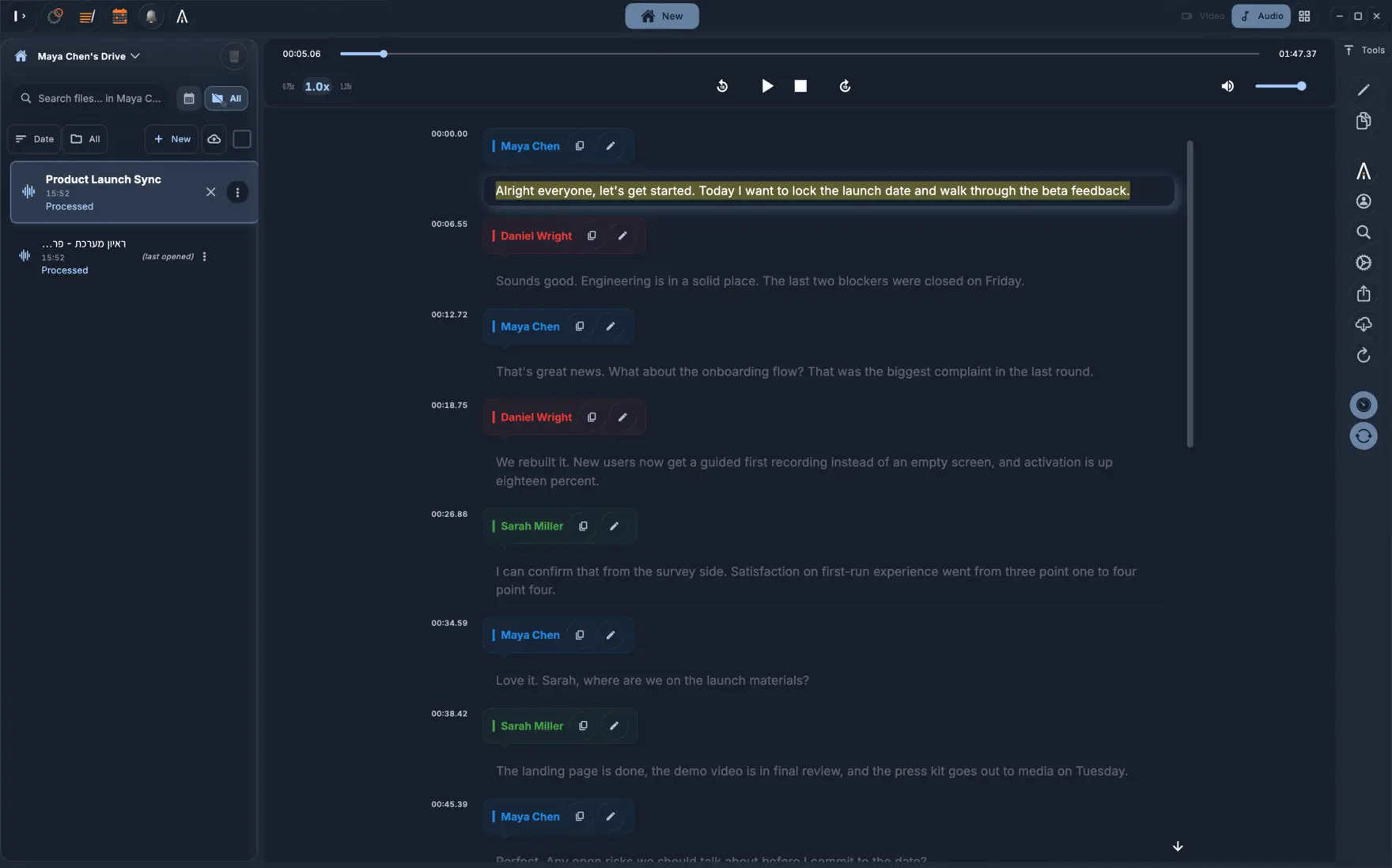
Keep your scoring sheet open next to the transcript. Highlight the answers that back up each criterion and jot down the timestamps. If you use KolWrite, you just upload the recording to get a transcript with speaker labels and timestamps, letting you search the text and jump right to that part of the audio. No bot ever joins the call.
Listen to the audio to double-check names, employers, job titles, technologies, and numbers before putting them in a report. Automated transcripts make mistakes, and getting an employer or a year wrong in an interview record can skew a hiring decision. If a candidate switches between Hebrew, Arabic, and English in the same sentence, check those parts by ear.
Put the evaluation in your own words and only use direct quotes here and there. If a hiring panel looks at your notes, they shouldn't have to read the entire conversation to see why a candidate was picked.
How long should you keep interview records?
Decide on your retention schedule before you begin and write it down. Follow your company policy and local laws, keeping records only as long as it takes to make the hiring decision and cover the window for any potential challenge. Let candidates know the timeline upfront, and delete both the recording and the transcript when that time is up. Some teams erase the audio sooner and only hold on to the structured evaluation.
Candidates may have the legal right to view their personal data or ask you to delete it. Keep your files in one place with a clear naming system so you can find a person's records quickly if they ask.
How do you keep interview data safe?
Treat interview records like any other confidential personnel file. Restrict access to HR and the hiring panel, keep transcripts inside a controlled workspace, and do not forward them over email. Before you pick a transcription tool, check where it processes and stores audio. KolWrite lists its setup on its security page: encrypted connections, AES-256 storage, servers in Germany, named AI providers, and no AI training on customer content.
Do not reuse interview recordings for anything the candidate did not agree to, like training or marketing, unless you go back and get their permission for it.
Common questions
Do I need the candidate's permission to record an interview?
Yes, you should always ask, and the law may require it. Since rules vary, check with your legal or HR adviser. If the candidate declines, do not record.
Can AI rate candidates from an interview transcript?
Do not let software make decisions for you. Automated scoring can be unfair and is regulated in some places. Use the transcript as evidence to back up a human's structured evaluation.
How long should we keep interview recordings?
Only hold on to them as long as your company policy and local laws require to make the hiring decision and cover any potential challenge. Set the schedule ahead of time, tell the candidates, and delete the files when the time is up.
What if the transcript misunderstands a candidate's accent?
Never penalize a candidate for a transcription mistake. Automated tools work less reliably on some voices, so you should always review the text, listen to the audio to check unclear spots, and fix any errors.
Can KolWrite transcribe interviews in Hebrew and Arabic?
Yes. KolWrite transcribes over 100 languages and gives first-class support to Hebrew and Arabic, including speech that mixes Hebrew and English. Still, always check the transcript before you use it.